Merit Recognition and Reward: The Role of Valor in Your Platform
Why a visible ladder of trust, like a military ribbon rack, motivates members more than an ID gate ever could.

When you implement TruAnon, it's far more than identity confidence. It's a measured ladder of trust. It offers visible indicators members want for themselves and respect in others.
The lobby and the penthouse
Think of your platform as a hotel. Onboard easily and enter the lobby, look around, and see who's there. But if you want to take the elevator up? You need keys. A Credible rank is statistically equivalent to ID, but far more transparent and far more useful. It's part of a ladder of trust. That trust isn't granted by authority, it's a reflection of prior history, a hand extended in good faith and accountability.
Memebers share the expectation of meeting other good people. Visibility makes that easy, natural, and powerful all at once.
Stars and ribbons
When a military professional gains experience or shows exemplary valor, it's memorialized with a ceremony, a medal, and a ribbon they keep. The rack of ribbons only grows, and it's a direct reflection of how powerful merit, recognition, and reward truly are for your platform.
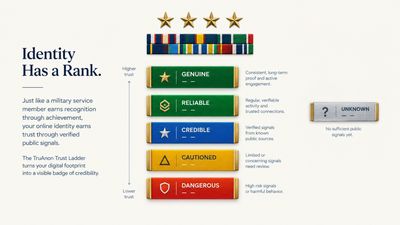
Credible, Reliable, and Genuine reflect growing depth of history. Cautioned is a transition state, and Dangerous means the pursuit was abandoned. Unknown sits apart: never anchored, or simply turned off.
Your platform makes merit valuable by making it clearly visible.
This is a bit of gamification; your guidance and governance transition from authority-driven to community-driven. People want to showcase the links and profiles others already know them, transitioning responsibility back to the rightful owner.
You don't do anything. Members make it work because it benefits them.
Medal, ribbon, rack
When someone becomes a Top Seller or a Trusted Buyer, it's like a new ribbon on a general's chest. They earn this by using your platform, it adds to the value they already bring: confidence in their claims, legitimacy in their actions, and transparency in their interactions with others.
This is visible, natural, and needs no instruction or study. The safety effect is immediate and community-wide. Your platform extends this value with the recognition your best members achieve.
People filter themselves and prefer other trusted, badge-wearing members.
Don't ask for everything at the door
Most identity is like a gate. Once a bad-actor has past, all their actions are blamed on someone else. TruAnon flips this script. Continuous identity proofing elevates members, rather than forcing reviews or disputes that ruin the experience. It's a safety rope you'd be conspicious to avoid, but it also leads right back to you. This structure means accountabilty.
Of course, many sites are attacked by fraudsters, and this can be "gated". Perhaps members must attain Credible rank before they can post. It's up to you how you weave identity into the evolution of your platform and respond to threat actors. This undermines the financial basis so threat-actors move on to less trusted platform.
What is shown is your choice, too. A dating site wouldn't display contacts or social links by default. Social media might showcase location or an age range, or just the rank and score on a post that is anonimous. Those claims aren't hollow: I do not have to see which properties you anchored when I know they are equivalent to my own. A dating site might let one member ask to securely reveal the profile behind that score before meeting in person. On a social site, there'd be little point. Members use features as they see fit, and you decide which ones your platform offers.
Age as confidence, not a gate to fake
Many regions have age-related restrictions. Laws and regulations around the world require users to be over 13 or 16. Many sites require you be an adult to take part in certain activities, and others require "Over 21" for simple purchases like cigarettes or alcohol.
Taken online? A photo ID is just a single claim —it's easy to fake and cheap to steal. Here? Age is backed by a variety of digital counterparts: the full weight of that member's report. "Over 18" from a Credible member is something you can lean on, same as ID. The same claim from a Dangerous member isn't. And members often boost their rank past Credible to reflect Reliable or even Genuine status.
Why? It's valuable because your platofrm makes it so. If being Credible is useful, then being Reliable or even Genuine must be more so. Your platform can leverage this natural tendency without coercion or force. Members can do more, more safely, and this benefit is the same anyone legitimate.
"Unknown" is a valid state
Platform owners sometimes ask why we suggest they present an Unknown state as a visible indicator. Unknown is a valid badge state. It's like a switch membeers can turn on to reflect credibility and, if they ever want to, turn off again.
People don't often do this, but offering the option does two important things:
-
It shows that identity proofing is continuous. Transparency is hard for fraudsters to maintain in public over time, and it costs them. They are discovered more quickly, and they lose all the properties they forged or stole. Credible members cannot return without pain of increasing cost. No verification solution prevents every situation. Our job here is to make profile fraud obsolete. Fraudsters move-on to less trusted platforms because these tools offer them no value; they expose them instead.
-
It shows that members have a choice. Anchor, grant, and revoke are digital rights. Your terms of service (TOS) already say how members are treated; TruAnon makes those rights part of your platform's visible structure, something everyone can see and rely upon. It reflects your terms rather than enforcing them by authority. Even if your platform changes hands, members still decide how others view and share their identity.
Unknown is part of your brand and your ethos as a trusted platform; this trust signal is recognized by members regardless of language or location. It means your platform has returned the responsibility for identity to its rightful owner: the individual.
Wearing it well
A profile is the perfect place to reflect a full, richly adorned badge of trust: a "ribbon rack." It's where medals are showcased for all to see and admire, a point of pride and achievement.
But there's so much more. The color of your rank is also a symbol of trust. Coloring a photo border is a common and simple way for that trust to follow you, even before others investigate your profile.
A colored checkmark can raise an explanation panel to help members trust. People can't fake a badge by adding an emoji to their name, and others can read how this rank is understood in your community. It's small enough to follow nearly anything members do, from posts to comments to activities within your system.
Put this all together and it's just like the medals and ribbon rack military professionals wear with pride. It's a symbol of who you are and the value you bring. Identity confidence is now an active part of your platform experience.
You can still revoke a ribbon or ban a member. What changes is that a banned member can't return with a differnet name or new email. Properties have only one owner, and the anchor can't be removed. Members can always revoke visibility, because that's their digital right, but they can't erase the anchor.
This confidence can't be spoofed. False valor carries a significant risk of exposure and loss that fraudsters simply avoid. Identity is now part of your brand and structure. Fraudsters move to less trusted platforms.
Join the circle of trusted platforms simply by offering TruAnon as a privacy-conscious alternative. This is something people adopt because your platform makes it valuable to do so, not by force. This subtle change in how we view identity confidence sets you apart.